Pages

Ads 468x60px

Nigerian community marches in 'solidarity' as Greenwich leaves tributes to murdered soldier Lee Rigby

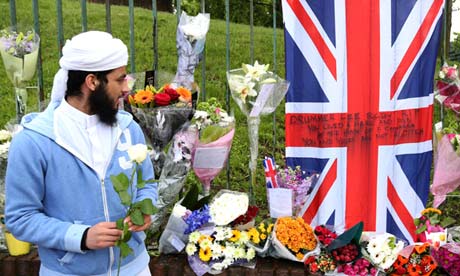
Union and St George's flags draped among flowers, along with Manchester United football shirts

Touching tributes continued to be paid to Drummer Lee Rigby in Woolwich today, as the community stood united in condemning the soldier's brutal death.

A steady stream of well-wishers added to the hundreds of flowers left at the corner of John Wilson Street, where three days earlier the 25-year-old father-of-one was hacked to death by two suspected terrorists.

In one heartfelt tribute, a picture of Drummer Rigby with his son Jack was pinned to the railings, with the caption "Daddy and his little soldier! R.I.P Lee".

Union and St George's flags were draped among the flowers, while a number of Manchester United football shirts were on display to recognise Drummer Rigby's lifelong support of the club.

Emotions were clearly still raw when a young woman broke down in tears as she arrived to see the mass of floral tributes.

The woman, wearing a green hoodie, sobbed and wiped tears from her eyes with a tissue as she read messages of condolence left for Drummer Rigby.

She was surrounded by more than a dozen friends and family members, many of whom appeared visibly upset.

The group left the scene after about 10 minutes without speaking to members of the press and walked towards Woolwich town centre.

Nigerian Kanbi Ojelade, 50, was among those paying their respects today, along with his two sons, Umran, 10, and Feranmi, 11, who both live in Woolwich.

Mr Ojelade, who lives in Colchester, said: "I brought them here to realise people are responsible for their freedom, safety, their welfare and development.

"The ultimate price anyone can pay is to give his life for others."

Royal British Legion member Charles Clayton, 66, said he believed the Government could have done more to identify the terror suspects earlier.

"He shouldn't be forgotten," Mr Clayton said.

"It demonstrates the society we now live in. I blame the Government for allowing this to go unchecked which puts us all at risk."

Scores of motorcyclists supporting the Help For Heroes charity rode past the scene this afternoon in a show of support for Drummer Rigby's family.

A heavy police presence remained in Woolwich amid heightened fears of further attacks and an increase in anti-Muslim incidents following Drummer Rigby's death.

A "solidarity march" by the Nigerian community took place this morning from Plumstead station to Woolwich town centre.

A steady flow of people arrived to lay flowers at the corner of John Wilson Street and Artillery Place, a few hundreds yards from the entrance to the barracks.

A book of condolence has also been opened at Woolwich Town Hall, where opening hours will be extended over the bank holiday weekend to allow the public to pay their respects.

Drummer Rigby was hit by a car and then attacked with weapons including a knife and a meat cleaver but the cause of his death was not confirmed by a post-mortem examination. An inquest is due to be opened, Scotland Yard said.

Among those paying their respects yesterday was British National Party (BNP) leader Nick Griffin, who claimed he had gone for personal rather than political reasons.

Mr Griffin's visit was criticised as "provocative" by Akbar Khan, chairman of the anti-racist and community development organisation Building Bridges.

He said: "It is a provocative action by Nick Griffin, the BNP leader, to go to the place where this young soldier was murdered. All Muslims have come out and condemned this act of violence.

"Given the serene and sad atmosphere prevailing in the country, because of this person's death, he is being very cynical and exploiting the raw nerves for his benefit, and we say it is just and fair that there should be no politics over dead bodies.

"Whoever is involved in this kind of activity needs to look very carefully at what that person is doing.

"We need to be calm and deal with it in a mature and responsible manner."

Drummer Rigby's murder has provoked a backlash of anger across the country, with many incidents of mosques being attacked, racial abuse and comments made on social media.

48 rescued as tourist boat runs aground of Welsh coast

Forty eight people have been rescued from a passenger boat after it hit a rock on a Welsh island this afternoon, coastguards said.

The Lady Helen sent out a mayday call just before 1pm saying it had run aground at Little Sound, part of Skomer Island off the Pembrokeshire coast and was taking on water.

Milford Haven coastguard said it launched a massive rescue operation including local lifeboats, a police boat and an RAF rescue helicopter from north Devon.

But all the 48 passengers and crew were rescued safely by other vessels in the area who had been alerted to the sinking ship.

There were no reported injuries to passengers or crew, a Maritime and Coastguard Agency spokesman said.

A coastguard spokesman said: "At 12.55pm today Milford Haven Coastguard received a mayday call from the passenger vessel Lady Helen, with 48 people on board reporting that they had run aground near Skomer Island and were taking in water.

"Milford Haven Coastguard contacted other vessels in the area by radio and requested Angle and St Davids RNLI lifeboats to attend and the rescue helicopter from RAF Chivenor.

"The passengers were evacuated to other vessels and have been transferred to shore safely where they were met by Broadhaven and Dale Coastguard Rescue Teams.

"There were no injuries to passengers or crew."

The vessel had gone to the island from nearby Martin's Haven and was going back there under tow after being refloated, he added.

The island lies within the Skomer Marine Nature Reserve, a popular spot for wildlife tourism which is a haven for Atlantic grey seals.

The passengers on board the boat reportedly included children.

Pembrokeshire GP Dr Pauline Smith told the BBC she picked up passengers on her friend's boat.

They were on their way out to go scuba diving when they heard the mayday call.

She said: "We had quite a few children and elderly ladies on our boat.

"The children were initially a bit scared. They said the boat had been listing.

"But once we gave them a Twix each they were fine."

David Beckham left out of final Paris St-Germain match of the season


Superstar has played his last competitive match

Former England football captain David Beckham has played his last competitive match, having been dropped from the Paris St-Germain team to face Lorient.

The global icon bid fans a tearful farewell last weekend, when he played his last home game for the newly crowned French champions against Brest.

Sources last week told The Independent that Beckham hadn't expected to play this weekend.

Beckham leaves PSG with a French Ligue 1 winners’ medal to add to his triumphs in the English, Spanish and US leagues.

Attacks on Muslims soar in wake of Woolwich murder

Anti-Muslim incidents, online and in person, increase from a handful to 150 since Wednesday as arrests are made across UK

Anti-Muslim attacks in Britain have soared since Wednesday's murder of Drummer Lee Rigby in Woolwich.

Faith Matters, an organisation that works to reduce extremism, said it had been told of about 150 incidents in the last few days, compared to between four to eight cases before Wednesday.

Fiyaz Mughal, the director of Faith Matters, said incidents were happening on the streets and online. "What's really concerning is the spread of these incidents. They're coming in from right across the country," he told the BBC.

"Secondly, some of them are quite aggressive; very focused, very aggressive attacks. And thirdly, there also seems to be significant online activity … suggesting co-ordination of incidents and attacks against institutions or places where Muslims congregate."

Police have reported several arrests since Wednesday. Benjamin Flatters, 22, from Lincoln, was arrested on Thursday after complaints were made to Lincolnshire police about comments made on Twitter that were allegedly of a racisut or anti-religious nature.

A second man was visited by officers and warned about his activity on social media, according to the police.

The charge comes after two men in Bristol were arrested and released on bail for making alleged offensive comments on Twitter about the murder. A 23-year-old and a 22-year-old, both from Bristol, were held under the Public Order Act on suspicion of inciting racial or religious hatred.

Detective Inspector Ed Yaxley of Avon and Somerset police said: "These comments were directed against a section of our community. Comments such as these are completely unacceptable and only cause more harm to our community in Bristol."

Two men will appear at Thames magistrates court on Saturday charged with religiously aggravated threatening behaviour over an incident in an east London fast food restaurant on Thursday.

Labourer Toni Latcal, 32, and plasterer Eugen-Aurelian Eugen-Beredei, 34, both from London, were arrested following the incident at 9.15pm on Thursday. Latcal was charged with religiously aggravated threatening behaviour and causing criminal damage, while Eugen-Beredei was charged with religiously aggravated threatening behaviour.

In Hastings, Adam Rogers, 28, of Kingsman Street, Woolwich, was arrested on Friday and will appear at Brighton magistrates court on Saturday accused of sending an "offensive, indecent or menacing message" online.

Car insurance: one bump and your old car could be on the scrapheap

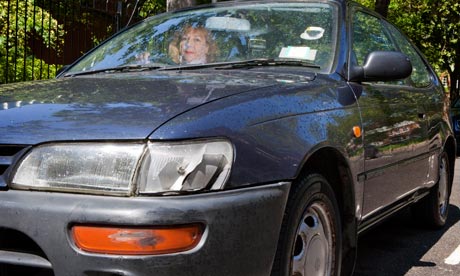
When Lesley Hall claimed for minor damage to her old Toyota Corolla, her insurers said her car was a write-off and offered £40

Drivers of older cars are being advised to think carefully before they are tempted to claim on their car insurance following a minor bump. The warning comes after one London motorist had her vehicle written off following the smallest of accidents, in which just the side light on her ageing Toyota was broken.

Lesley Hall, who lives in London, was told by her insurer, Covéa, that it would send her a cheque for just £40 for her perfectly usable and very reliable L-registration Corolla, after an engineer decided it wasn't worth repairing.

Hall, who works for a housing trust, says she wishes she had not claimed at all, but describes the £40 offer she received from Covéa as an insult.

The French company, which provides car policies on behalf of Lloyds bank, has since backtracked, but the case shows the crazy way that insurers can treat the owners of older cars, and why in the majority of cases you would be better off not to claim.


It also shows up how little consumers know about the write-off procedure and their rights if they are on the receiving end of the process. The collapse in the value of older cars, coupled with the increase in repair costs in recent years, means it has reached the stage where cars with any kind of damage are increasingly being written off.

"I have been driving for over 40 years and have never claimed from my car insurers. I have a nine-year no-claim bonus," Hall says. "I ran into a car door, and although I only broke a side light on my car, I had to put in a claim for the other car. I did not realise at the time that I did not need to claim for my damage."

After a claim was filed, the insurers sent an engineer, who produced a report saying it was not economic to carry out repairs given his valuation of the vehicle at just £312. In spite of the fact that the only damage caused by the accident was the broken indicator glass, he took into account the other minor scratches and dents Hall had accumulated during 12 years of driving on London's roads.

In her case the repair costs of fixing a sidelight were never going to exceed her £200 excess – the first proportion of the claim which she would have had to pay – but no one at the company pointed this out.

When she complained to Covéa at being given just £40, she was told it was not possible to withdraw her claim as the engineer had already inspected her vehicle.

"My car, although old, has always been regularly serviced and has an MoT until next February," she says. "I've had it 12 years and it has never let me down. I know that it is not worth a lot, but the money offered by the insurance would not even buy a new tyre. It all seems rather unfair."

Following the Guardian's intervention, Covéa has said it will no longer write off her car and has substantially upped its offer. Instead of the £40 it originally offered, it will now pay her £533, after a reduced £100 excess has been deducted.

A spokesman for Covéa says that its engineer used established insurance industry guidelines to come up with the valuation, taking into account the car's low mileage and the condition of the bodywork.

This has since been revised upwards "as a gesture to recognise that at some time during her claim we felt our service had fallen short of our usual standards".
How your car will be assessed

Insurers will write off a car if the cost of the repairs is as little as 60% of its deemed value. Vehicles that are worth £5,000 could be considered to be beyond economical repair if the costs exceed £3,000. Assessors use four categories of car insurance write-off to rank the seriousness of accident damage. Vehicles in categories A and B are very badly damaged and cannot be put back on the road, but categories C and D are for "economic write-offs" – where damage is costly but not necessarily dangerous and can be driven subsequently.

The Association of British Insurers says that insurers will generally listen to customers who want to put their car back on the road and adjust the payout to reflect that. They will usually hand it back and deduct the car's scrap value from the payout – further reducing the final amount you receive – making the original idea of claiming even less worthwhile.

Insurers declaring a category C write-off will inform the DVLA and a Vehicle Identity Check marker is put on the file. It you want to carry on using the car, you need to have it checked to establish the vehicle's identity and clear the marker. The test costs £41. Cars that are given category D write-off status are not required to do this. Plenty of category C and D cars are driven for years after being written off.

Most of the disputes with insurers revolve around the car's valuation. Insurers, particularly those at the lower end of the cost spectrum, will invariably offer the lowest figure they think they can get away with. You don't have to accept it – if cars in your area in the same condition and mileage are making more, point this out – and supply the evidence. If your car has an expensive service history, plus recent tyres, new tax disc etc, make this point.

If you are not happy with the outcome of the claim, take the case to the Financial Ombudsman Service, where you should be given a sympathetic hearing. In the past it has accused some insurance companies of valuing by trade price – the amount a dealer would pay – rather than the higher retail price.

Woolwich suspect was victim of frenzied knife attack aged 16

Michael Adebowale, who remains in hospital, was caught up in incident in which fellow victim was 'cut to pieces'

One of the men arrested for hacking to death a soldier in a London street witnessed a murder and was himself stabbed in a frenzied knife attack five years ago, the Guardian has learned.

Michael Adebowale, who was pictured holding a blade minutes after the murder of Drummer Lee Rigby in Woolwich on Wednesday, had been caught up in an earlier fatal incident in January 2008 when he was 16.

One person was murdered in the bloody episode, having been "literally cut to pieces" by an assailant wielding a 12-inch knife, according to the judge at the trial that followed the incident, which happened on a housing estate in Erith.

Adebowale is now in a London hospital, under guard, after being shot by police at the scene where Rigby's body was found, stabbed with weapons including a knife, a cleaver and a machete. He and another man, Michael Adebolajo, have been arrested in connection with the murder.


Background information about Adebolajo, 28, was circulating soon after Wednesday's gruesome murder but it took a day before Adebowale's name began circulating in public. Relatively little has been known about his background until now.

A Greenwich neighbour of the 22-year-old said that after the earlier knife attack Adebowale disappeared for a year and converted to Islam, and that his character appeared to have changed.

The 2008 attack which Adebowale witnessed and suffered gives an insight to a life in chaos. It led to a trial that saw Lee James, 32, convicted of murdering an 18-year-old, Faridon Alizada, stabbing a 16-year-old in the neck, and stabbing Adebowale in the shoulder and hand.

According to information released by the Metropolitan police after the December 2008 trial: "Faridon Alizada was inside the flat with two friends (victims 2 and 3) when James entered the flat on the pretext of buying drugs.

"Having armed himself with a knife before going to the flat, he then attacked the three teenagers, fatally stabbing Faridon. Faridon died of his injuries at the scene.

"A postmortem later revealed two stab wounds to the chest over six inches deep, either of which would have been fatal."

According to a report in the local newspaper, the News Shopper, James went to the flat on the Larner Road estate from where drugs were sold. He visited it daily and was planning to rob those inside. Faridon was in the flat with the two 16-year-old friends when James entered at 3am, with another man. He was carrying a 12-inch knife hidden under his jacket and bought and smoked crack cocaine.

Sentencing James to life imprisonment, Judge Anthony Pitts said Faridon had tried to save the others, even after being stabbed. "He was literally cut to pieces by Lee James who went on to stab a third man, fortunately not so seriously.

"The murder was in the end only of one person but that was sheer chance. [Another victim] was wounded very, very seriously and was extremely lucky not to have been killed or incapacitated for life.

"Faridon had the extraordinary courage it seem to me to attempt to confront Lee James, not only to protect himself but also to protect the other 16-year-old. It was, of course, a hopeless mismatch."

The trial at Southwark crown court heard that James, a former bare knuckle fighter, accused Adebowale and the other youths, who were Afghans, of being members of al-Qaida and plotting to carry out explosions. The court heard claims that James was suffering from a drug-induced psychosis during the attack.

Madeleine Edwards, a family friend who lived in the same block of flats as Adebowale in Greenwich, south London, said he had been involved with a local gang – the Woolwich boys – when he was a young teenager and had been in "some serious gangland trouble".

She said he had been a witness in a high-profile murder trial and that his mother had said he had to "disappear for a while." He left for about a year and when he came back he appeared to have converted to Islam and had become distant. "He could see my disdain at the direction he had gone in," she said.

Police investigating Adebowale raided a flat on the fourth floor of a block in Greenwich on Thursday, about four miles from the site of Wednesday's attack.

Neighbours at the scene said the small flat in Macey House was the home of Adebowale, who they said lived there with his mother, although this has not been confirmed by police.

"I was so shocked when I saw his picture on the television," said Jonathan Ackworth, 42, who lives in the block. "I used to see him coming and going and would say hello – he seemed perfectly pleasant. Everybody is in total shock."

Ackworth said he had seen both suspects around the block of flats and the second attacker had lived at the address with his mother for several years and attended a local college in Greenwich.

Another neighbour, 22-year-old student Alexander Sargent, said: "I knew him mainly by sight. We'd see each other in the lift and say hello. He dressed quite 'street', if you know what I mean. I've not seen him around for a few months."

On video of the attack on Rigby on Wednesday, Adebowale can be seen carrying a knife, talking to passersby.

Footage shows him rushing at armed police when they arrived on the scene and being shot.

Adebowale and Adebolajo remain at separate hospitals where they are still too ill to be interviewed.

Woolwich suspect's friend arrested after appearing on Newsnight

 Man detained after claiming on television that Michael Adebolajo was tortured in Kenya and harassed by MI5 agents

A friend of one of the suspected killers of a soldier butchered in a London street was arrested by counter-terrorism officers yesterday after going on television to allege that Michael Adebolajo was tortured in Kenya and harassed by MI5 – who asked him to spy for them.

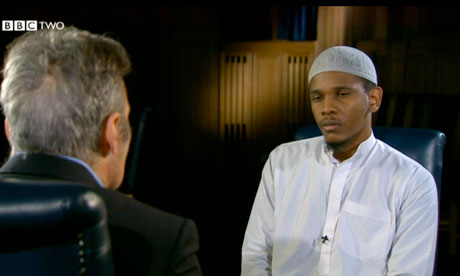
The allegations came from Abu Nusaybah, who was arrested under terrorism legislation minutes after finishing recording his interview for BBC Newsnight.

The Guardian understands that Nusaybah is connected to extremists formerly in the banned group al-Muhajiroun. Counter-terrorism officers turned up at reception at the BBC's central London headquarters as his interview was being recorded an hour before it was broadcast. The officers waited, then arrested Nusaybah as he left the BBC's headquarters.

In the interview, Abu Nusaybah in part attributed Adebolajo's radicalisation to his alleged ill-treatment in Kenya.

Nusaybah alleged that Adebolajo was arrested while studying in a village in Kenya last year. After refusing to answer questions, Adebolajo was told that he was "not in the UK" and was then, he claimed, sexually assaulted. On his return, "he became more reclined [sic], less talkative. He wasn't his bubbly self," said Nusaybah, who said that the experience further radicalised Adebolajo.

The Guardian has learned that, last year, Adebolajo went to a lawyer to complain of harassment by MI5, who are drawing criticism today for knowing about the 28-year-old but not assessing him to be a bigger terrorist threat.

He was arrested at the scene of the soldier's murder in Woolwich on Wednesday in the first terror-related death on mainland Britain since the 7 July 2005 bombings.

The Guardian also understands from Whitehall sources that they were aware that Adebolajo was detained in Kenya before being deported.

Nusaybah said he had known Adebolajo since they grew up together in Romford, Essex.

Since the attack on the soldier, Lee Rigby, on Wednesday, a total of six people have been arrested. Nusaybah's was the first under counter-terrorism laws; the rest have been detained under regular criminal laws. Nusaybah was arrested on suspicion of the commission, preparation or instigation of acts of terrorism under the Terrorism Act 2000.

Asked about the unusual sequence of events leading to the arrest, the Metropolitan police said: "He was not arrested because of his comments on Newsnight."

The police would not say what led to his arrest, which BBC insiders said had left them shocked. Police also said he was not arrested in connection to the murder of Lee Rigby. Nusaybah's home is understood to be one of two addresses in east London being searched by officers after his arrest.

In the interview, Abu Nusaybah described how the two men became friends after meeting in Romford in 2002, before both had converted to Islam. "I used to go there to chill out with friends," he said. "One day we bumped into each other. You didn't see a lot of black guys down there, so we talked and swapped numbers." The two men converted to Islam independently in 2004. "I came into Islam in 2004 and he came in four months later," Nusaybah said.

He also confirmed that Adebolajo frequented meetings of the now-banned al-Muhajiroun group, where he listened to the preachings of extremist clerics. "He attended some of their activities, but he was an independent guy. He would float about," Nusaybah said.

Adebolajo did not want to see sharia law imposed in Britain, but thought it more sensible for someone like him to go and live in a Muslim country, according to the interviewee. "He wanted to be qualified to teach and to do fitness training. He could use that to go abroad and live in a Muslim country."

Abu Nusaybah said that he believed that Adebolajo became radicalised about six months ago. He said he saw profound changes in Adebolajo's character at that time, which he attributed to his experiences in Kenya and to events on his return to Britain. "I believe that certain events that happened to him recently had an impact in shaping the changes. He became more reclined [sic], less talkative. He wasn't his bubbly self," he said.

Adebolajo had told Nusaybah how he had gone to study in a village in Kenya when he and others were rounded up by the Kenyan army. When he was interrogated, he refused to speak. "They told him, 'You are not in the UK now.' They took his private parts and said, 'We will F you.' He told me he was physically assaulted and sexually threatened. If you looked at his face, he was holding back tears," Nusaybah said.

When Adebolajo returned to England, he was interviewed by MI5 officers and, according to Nusaybah, was planning to leave again to live in a Muslim country. "His whole concept was he wanted to live in a Muslim land because at the time he was being harassed by MI5.

"They were knocking and knocking on his door. He pretended not to be there, but then he spoke to the agent. They said, 'We just want to speak to you.' They wanted to ask him if he knew certain people," he said.

"But after him saying that he didn't know these individuals, he said they asked him if he would be interested in working for them. He was explicit in that he refused to work for them but he did confirm he didn't know the individuals."

"His word was, 'They are bugging me,'" said Nusaybah.

In a statement about the arrest, Scotland Yard said: "At around 2130 hours on Friday 24 May, a 31-year-old man was arrested in London by officers from the MPS Counter-Terrorism Command on suspicion of the commission, preparation or instigation of acts of terrorism under the Terrorism Act 2000. The man has been taken to a south London police station, where he remains in custody. Search warrants are being executed at two residential addresses in east London."
 

Sample text

Sample Text

Sample Text