Pages

Ads 468x60px

Terrorism: life-denying ideologies have no place in this country

So entwined have the English Defence League and radical Islam become, they might as well be married

With the predictability of acne spreading on a teenager's face, the British right and left used the ritual slaughter of Lee Rigby to confirm what they already knew. The security establishment called for the revival of its pet project to allow spies to engage in blanket web surveillance without saying why it would have helped. For the "anti-imperialist" left and Greens, who have never wanted to look clerical fascism in the eye for fear of what they may see, the attack told them that the west was to blame – as it always must be.

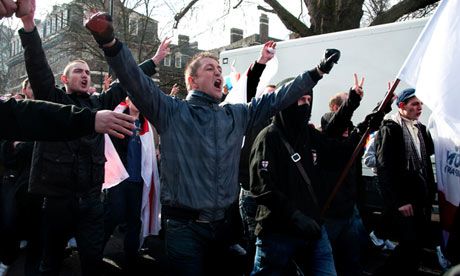
Neither could accept that political violence is mutating in ways that give past cliches a musty smell. For the first time since 9/11, the similarities between violent movements in the west are more important than their differences. They replicate and feed off each other. So entwined have the English Defence League and radical Islam become, they might as well be married.

The security services are not saying whether the Woolwich suspects had links with international terrorism. Perhaps they did, but no one would be surprised if they spent their days in Britain listening to Anjem Choudray and surfing the web. This is not the way it used to be. We still have cases where terrorists follow the traditional pattern. The courts convicted Richard Dart in March after he had gone to Pakistan to work on a plot to blow up families mourning the army's dead at Royal Wootton Bassett. But in most instances, with Osama bin Laden dead, and his associates blown apart by drone strikes, we are now reduced to talking about the once fearsome al-Qaida as "a franchise", a phrase that trips too easily off the tongue.

The best response to those who argue that the "root cause" of the terror is western foreign policy is to reply that it may be in some cases. But when you face a psychopathic movement, it says more about you than it if all you can see is a protest against whatever you happen to dislike about your government.

The Pakistani Taliban attacks girls who want a decent education. (And some elements of the British left ought to show more pride that Drummer Rigby and his comrades fought in Afghanistan to stop the Afghan Taliban doing the same.) It also murders Shia Muslims, Christians, Ahmadis and Pakistani liberals.

In Timbuktu, the Ansar Dine destroyed beautiful mosques, which did not accord with their ultra-puritanical version of Islam, an act that to my mind seemed truly Islamophobic. Meanwhile, Boko Haram terrorises northern Nigeria and al-Shabaab terrorises Somalia. None of these organisations is terrorising because they want to make a legitimate if regrettably bloody critique of "the west". They terrorise because they want to establish a misogynist and inquisitorial theocracy.

Though they share much of the al-Qaida ideology, and in the case of elements within al-Shabaab, proclaim allegiance to al-Qaida, they cannot reasonably be described as "franchises". Unlike al-Qaida in Iraq in the 2000s, they do not take orders from a central command. Indeed, the US military has ensured there is no central command to take orders from.

The uncertainty applies to the experience of far luckier countries in the rich world. Rather than the mass murders of 9/11 and 7/7, we are seeing small and vicious attacks that are rarely planned in the hills of Waziristan.

As one security source put it to me: "For the time being, terrorists threaten fewer people but are harder for the security services to monitor and infiltrate."

Alexander Meleagrou-Hitchens of the International Centre for the Study of Radicalisation has chartered the change by analysing the writings of al-Qaida leaders since the "high point" of 9/11. After Nato had driven al-Qaida out of Afghanistan, Anwar al-Awlaki, al-Qaida's most effective propagandist, could no longer dream of a global insurrection. Instead, he saw hope in the web. He wanted violence certainly. But his "44 Ways to Support Jihad" or al-Qaida's Inspire magazine, which al-Awlaki edited until the Americans killed him, shows the limitations of his approved methods of "individual jihad".

Supporters should attach "butcher blades" to the front of a pick-up truck, so that "the blades strike your targets at the torso level or higher", and drive into crowds, ran one idea. Brutal though the suggestion was, it was not a way to bring a government to its knees, as Bin Laden may have realised

His British followers were as violent and as vacuous. After Trey Parker and Matt Stone said they wanted to show Muhammad in South Park, a British Salafi website quoted al-Alwaki with approval and said: "We have warned Matt and Trey that what they are doing is stupid and they will probably wind up like Theo van Gogh if they do air this show."

Parker and Scott later created an irreligious musical for Broadway and the West End. But what with one thing and another, the religion they decided to go for was Mormonism. It is shameful to live in a society where it is easier for satirists to mock the Prophet Brigham Young rather than the Prophet Muhammed, but these are not signs that a global counter-revolution is on the march.

The attacks by radical Islamists in the west today are not very different from the attacks on mosques that followed the murder of Drummer Rigby or the bombings organised by the "dissident" IRA: small scale, mean in every sense of the word and pointless.

The similarities do not stop there. The founders of the English Defence League were inspired by Islamists who disparaged British troops. The EDL has in turn produced the Muslim Defence League. David Anderson, Britain's independent reviewer of terrorist legislation, is so concerned by the reciprocal relationship between certain religious groups and the white far right, he is thinking of investigating whether the police are treating both partners in this ugly waltz equally.

I am not trying to belittle today's violence. It is easy to imagine a one-off Islamist attack such as the stabbing of Stephen Timms or the bombing of the Boston marathon, leading to an attack on a mosque that claims lives.

I am simply saying that yet more powers for the police are not going to stop small groups of men acting almost on impulse.

It would be better if right and left in Britain could do what they have failed to do to date and condemn violence without regard for the colour or creed of the perpetrators, and without displaying an ounce of respect for the life-denying ideologies that motivate them.

Woolwich attack: 'Muslims are free of guilt. We had to condemn this killing'

A leading Islamic commentator and author reports on the swift reactions of Muslim groups to last week's killing
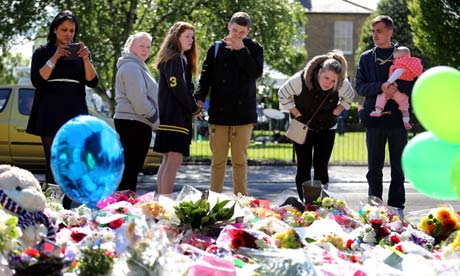
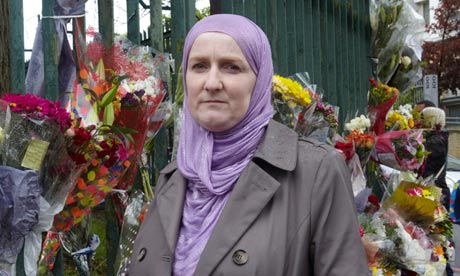
After Friday prayers, at the scene of last Wednesday's dreadful murder of Drummer Lee Rigby, Julie Siddiqi laid a bunch of flowers. "It was hard not to cry, especially when the imam raised his hands in prayer at the moment we laid the flowers," she said afterwards.

Siddiqi is executive director of the Islamic Society of Britain, one of the few women leading a national Muslim organisation and one of a growing number of Muslims of English origin. Her horror at the Woolwich attack is palpable: "It's echoed by the Muslims around me. There's genuine shock and outrage. The killing has really shaken people up."

The community's response was swift and unambiguous. Within hours of the incident, the Muslim Council of Britain issued a condemnation. "Whether it was to do with Muslims or not, it was right to express our horror at this disgusting event," says Harun Khan, one of the MCB's young leaders.

"But we were conscious, too, that the suspects had used Islamic words, and these would be used to demonise Muslims. We wanted people to know what happened was wrong, and there is nothing in Islam to justify it."

The MCB is an umbrella body for 500 mosques, schools and associations, so getting an agreed public statement out rapidly was difficult. "We knew it had to be quick and unequivocal," says Khan. The MCB's message was across news outlets later on Wednesday afternoon.

Social media was used alongside conventional media channels. "Our Twitter account went into overdrive," Khan says. "We were relentless in emphasising our condemnation, and amplified the voices of our affiliates doing the same. This was not just some leaders condemning the attack, it was the entire community." Attempting to guide young Muslims using social media away from Twitter hate wars and towards constructive dialogue was another aim of the quick response.

Siddiqi added: "The community is maturing. The response was different to 7 July. In 2005, our organisations weren't as developed. Now there's more confidence, Muslims are more proactive." She partly attributes this to the fact that as the length of the community's presence in the UK increases, connections between Muslims and wider society have become stronger.

As always, there was criticism by Muslims of Muslim organisations for being "apologists" through the condemnations. If these were two lone men acting against Islamic principles, and if the rest of Muslims are as guilt-free as Britain's general population, asked some, why the rush to apologise? Khan rejects this argument: "All decent people condemn such events. We do too. As members of this society, it is important we reach out and clearly express our position"

Siddiqi said she felt the need to reassure wider society and protect Muslims from a possible backlash: "We knew this incident would put people at risk, so it was a duty for us to respond."

The backdrop to their stance is the sense of a growing anti-Muslim hatred, and rise of the English Defence League.

The backlash against Muslims after the September 11 and 7 July terrorist outrages were painful for Muslims. Since then there has been a steady increase in hate crime against Muslims, amid growing poverty and the rise of far-right parties across Europe. Last week a letter to the Muslim Association of Greece threatened to "slaughter like chickens" Muslims who did not leave the country by 30 June. Many feel that a comparison can be drawn with 1930s Europe.

"Fear is widespread among Muslims," says Fiyaz Mughal, director of the Tell Mama (Measuring anti-Muslim attacks) project. There has been a very large spike in abuse, attacks and assaults on Muslims since Woolwich. "We used to receive four to eight cases every day. Since Woolwich we've had 162, from hijab and niqab pulling, to graffiti on mosques and cars. One man entered a mosque armed with knives. Mosques have been attacked with petrol bombs."

It is fashionable to deny that Islamophobia exists. "Evidentially," says Mughal, "that idea is dead. We have data that shows clear targeting of Muslims." He dismisses the idea that this arises from a sense of Muslim victimhood: "If people stop targeting Muslims then they won't be victims. Simple."

If anything, Muslims under-report attacks. "They don't want to make a fuss. They shrug it off," says Mughal. There are other reasons,. "People worry if they report attacks it will be their own details that get recorded. They're fearful how their data will be used."

One positive outcome of the tragedy is a stronger sense of community. Both Siddiqi and Khan feel that Muslim organisations have worked well together, establishing stronger relationships.

The notion of standing firm with British society is strong across the board. "All the community has so much pride in being British," says Esmat Jeraj, assistant secretary general for the Council of European Jamaats (congregations).

The mosque next door to COEJ in Streatham, south London, was used for an open-house community meeting on Thursday to discuss Woolwich. "We invited all our neighbours, local organisations, Safer Neighbourhoods teams and councillors," says Jeraj. She points out it was the only event of its kind in Streatham. "It was the imam's idea to organise it."

This open, cross-community role for Muslims is something Jeraj is keen to champion. "While we are practising Muslims, we have a responsibility as British citizens. Part of that work is countering lack of knowledge about Muslims and showing that mosques have nothing to hide, that they are open to all.

"Don't worry. We're not wishing for the government to be abolished or sharia to be imposed. We want people to know more about Muslims. We want to play our part."

Humour in the face of adversity is a British trait. TV presenters faced with the Islamic phrase "Allahu akbar" (al-laa-hoo), struggled valiantly to pronounce it, but mostly only managed "aloo akbar". What did potatoes (aloo) have to do with prayer, wondered some Muslims.

In terms of the media response to the death of Lee Rigby, aside from the ethics of publishing gory images, Muslims wondered if the event was politicised because of seeming connections to their religion. In a recent chilling murder allegedly inspired by anti-Muslim hatred, a 75-year-old Muslim man in Birmingham, returning from evening prayers, was stabbed to death outside his front door. It barely made the papers, let alone the front pages. Similar accusations of double standards were levelled at media and politicians for referring immediately to the Woolwich killing as an act of terrorism, before the facts of the terrible event had become known. .

During an early news report, the BBC's Nick Robinson described the suspects as of "Muslim appearance". He was criticised and subsequently apologised for using a phrase "liable to be misinterpreted and to cause offence". The apology was well-received but left some Muslims wondering about the predisposition of media and politicians to equate any criminal act conducted by a Muslim with terrorism.

Baroness Warsi, the minister for faith and communities, criticised media outlets for giving space to "nutters and idiots" such as Anjem Choudary, former head of the banned extremist organisation Al-Muhajiroun.

One of the suspects, Michael Adebolajo, was filmed with Choudary, and many believe Choudary may have influenced the alleged killer.

Khan says the MCB has been working to tackle the extreme messages Choudary is peddling. Just two weeks ago, Choudhary's supporters are alleged to have beaten up a Muslim man on Edgware Roadin London, in a horrific case of sectarian violence. A subsequent cross-sectarian forum co-organised by MCB posed searching questions for the police as to why this man was still at large.

Siddiqi, too, says that Muslims on the ground know of the threat that Choudary represents. "One local man at Woolwich mosque told me how Al-Muhajiroun tried to take over the mosque. They worked hard to push them out. But Al-Muhajiroun got a room from the council further up the road from which they conducted their activities."

Many Muslims feel they are tackling extremism, but that those in positions of power are letting them down. Siddiqi feels it is important to recognise that media organisations have tried hard to engage Muslim voices. "I've been doing interviews non-stop," she says.

"There's a sense of unity and purpose," says Khan. "But also a deep understanding that there's more to do. There is always more to do."

Police investigate allegations of sex abuse at Catholic boarding school

Former pupil claims monks at closed boys' school Fort Augustus Abbey committed 'systematic, brutal, awful torture'

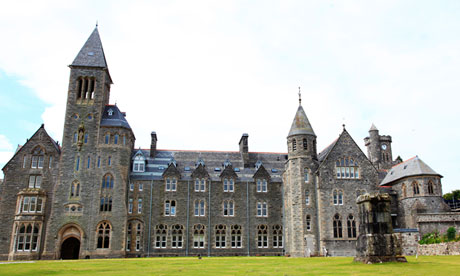
Police are investigating allegations of abuse at a Catholic boarding school in the Scottish Highlands, following complaints of a brutal regime in which boys were physically beaten, psychologically tortured and sexually assaulted. The school closed in 1993.

Officers from Police Scotland will travel to Newcastle tomorrow to interview Andrew Lavery, 41, who for two years in the 1980s attended the fee-paying Fort Augustus Abbey, which was run by Benedictine monks. "It was systematic, brutal, awful torture," says Lavery, who says he was beaten, sexually assaulted and isolated in a locked room for days on end under "special measures". He added: "The psychological torture was the most damaging. In the end I wanted to kill myself."

Lavery claims he was beaten unconscious by a monk and lay master while pupils watched, then left at the playing fields to crawl back to school. He also says he experienced "greying", which involved other pupils pinning the victim's legs apart while his testicles were hit with a hockey stick. A monk watched without intervening. "I have had pain in my left testicle all my life," he said.

Lavery also accuses Monk A, now a cleric in England, of physically beating and sexually assaulting him. He will tell police that when he broke his leg Monk A took advantage of his vulnerability and tried to grab his testicles. "I told him to leave me when I went to the toilet, but he was standing over me. He said, 'No, you need a hand.' I heard all his heavy breathing behind me. It was the wrong sort of breathing to hear in your life. He was fumbling and I was screaming at him to get off."

Monk A is also accused of selling alcohol to underage pupils. When contacted by the Observer, he admitted giving them beer, but said: "I never beat people up and there was certainly never any sexual stuff. I don't know what he's talking about."

There has been heated debate on the school's old boys website about abuse, with some denying it took place. Des Austin, a former pupil who privately investigated abuse at the school, posted extracts from 13 separate emails he received from old boys claiming physical and sexual assault from 1954-91. "The thing that got to me," one wrote, "was the sexual abuse ... and the fact that no one would believe me. My mother said, 'priests never do such things'."

Cardinal Keith O'Brien, who resigned as Archbishop of St Andrews and Edinburgh in February after allegations of sexual misconduct, was a visitor to the school and guest of honour at last year's old boys' dinner. Jimmy Savile, who owned a house in the Highlands, was also an occasional guest and Lavery remembers his Rolls-Royce being parked outside the monastery. Lavery was in a senior position as an addictions nurse until last year when he suffered a traumatic physical injury. While recovering, he suffered flashbacks, recovered memories and night terrors. He no longer works. He has been diagnosed with post-traumatic stress disorder and assessed as requiring psychotherapy and specialist abuse counselling.

Another former pupil, Douglas Hiddleston, from Fortrose, remembers Lavery being treated "viciously" by pupils and staff. One of the few Protestants in the school, Hiddleston says he was also targeted. "Monk A grabbed me by the throat, pinned me up against the wall and called me a Proddy bastard," he said.

Another pupil, who asked to remain anonymous, said Monk A "was the epitome of nastiness". The man, who says he was once nearly drowned by fellow pupils while staff watched, also alleges that another monk was guilty of sexually predatory behaviour and tried to "groom" him. "Seediness pervaded the school," he said.

The culture was similar for an earlier generation, according to some at the school in the 1960s. "I came close to suicide," said Sean O'Donovan, who says he was bruised for five weeks after a birching. "I just couldn't see an end to it.I tried using a rope, but it was too thin. It was very painful and, since I was trying to stop the pain, that made me think."

William Wattie, who attended from 1959 to 1964 and became a headteacher, said: "Institutionalised bullying … I could never work out where the gentle carpenter of Nazareth fitted in." He questioned "cuddling" by monks at the school's feeder primary at Carlekemp in North Berwick, which has also been linked to abuse allegations. The Catholic church in Australia accepted abuse had been perpetrated by Father Aidan Duggan, a former teacher at both Carlekemp and Fort Augustus. Duggan died in 2004.

Fort Augustus monastery, which belonged to the English Congregation of Benedictines, also closed in 1998. The current Abbot President, Father Richard Yeo of Downside Abbey, admits former pupils have contacted him regarding the school. "I have heard allegations of both physical and sexual abuse which have disturbed me. If anyone comes forward to speak to me about this, I will try to be there for them," he said.

'Knee deep in mud at an English festival? Give me Spain any day'


With the British weather always likely to turn Glastonbury or Bestival into a gruelling expedition, bookings are up by 30% this year for events abroad where fans can pay less to see the same bands – and the backdrop is the sunny Med or Adriatic

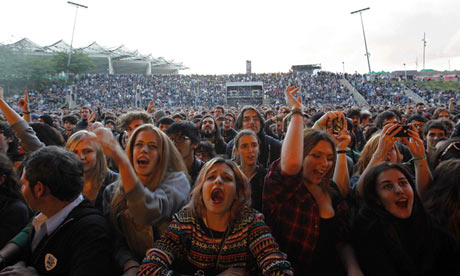
Approaching midnight at the Parc del Fòrum , the Barcelona air was still warm after the heat of the day. On stage, singer-songwriter Jessie Ware was in typically sultry form. At the back of the crowd, Gavin Blane, a 33-year-old Londoner, explained his decision to turn his back on Britain's festival circuit and head abroad.

"It's the best way to get away from our corporate jobs," said Blane. "Have a beach holiday, see some culture and party at night." Blane's choice of festival this summer came down to Glastonbury or Primavera Sound, where Brit old- stagers such as Dexys, the Jesus and Mary Chain and My Bloody Valentine are rubbing shoulders with Ware, Phoenix and Simian Mobile Disco. He has no regrets about opting for the sun. "Here you've got the beach, the hills, the sun. We all know what Glastonbury's like."

After bubbling along nicely for years, mass European music festivals have well and truly arrived. As the UK endures yet another damp squib of a spring and early summer, bookings are up 30% on last year at festicket.com, which caters to the booming demand for listening to British bands in Spain, Croatia, Sweden and beyond. It used to be that a rite of passage would be a weekend away at Reading or Leeds. These days, the average age of a festivalgoer in the UK is 36, and organisers are accused of targeting middle-aged nostalgia junkies with headliners such as the Rolling Stones and Elton John. A younger generation is looking to avoid the mud, rain and endless queues of the traditional British festival and hop on a budget airline.

Tour operators now offer bespoke European festival packages including tickets, flights and accommodation. "Taking in an overseas music festival this summer is a great way of combining two British love affairs – live music and summer holidays abroad," said Sean Tipton of the tour operators trade association Abta.

"Ticket prices in Europe are often much lower than the UK and food and beer is often a lot cheaper too. The range of options is very wide with the added bonus of more predictable weather; the traditional British festival mudbath isn't everyone's idea of fun."

Dan Fahey of Festicket said: "People are definitely looking abroad. It's the discovery angle – when you discover a new band you want be the first to hear it and tell others. This is the same."

He said: "It's not just the cheap flights and cheap beers – European festivals have really upped their game."

Enric Palau, director of Sónar in Barcelona, a pioneering electronic music and multimedia festival that is still going strong after almost 20 years, said he had seen a huge increase in the number of Britons buying tickets.

"We use museum spaces, indoor and outdoor venues in the city – quite different from an outdoor, inland event. Sonar is a city festival; it's a cultural experience in a main European destination. It's not just another headline mainstream event."

Sónar has been held in other cities too, including London (the Royal Festival Hall), São Paulo and Reykjavik.

Festivalgoers at Primavera enjoy the added bonus of a stunning urban setting built from the 1992 Olympics and looking out to a sea that last week was lit up by a full moon. James Swatton, 28, from London, said: "The architecture is stunning; it's unlike any other festival. The layout is quite incredible in the way that you can fast track your way to places. It's all facing out to sea, which is amazing. Plus I like going back and sleeping in a bed.

"You just don't get this kind of lineup anywhere else. Festivals in the UK are stuck in a rut," he said.

Pete Large, 23, agreed: "I love the architecture. It's definitely different in that there's no camping and it's all concrete. I'm used to the mud and the grass."

"English festivals are good, but only if the weather is on your side. If not, it gets frustrating and muddy," said Sylvia de Sousa, 29, from Chiswick, west London. "Being surrounded by the sea makes it feel more relaxed and the lineup is very interesting and eclectic – there's all sorts from Blur and Jessie Ware to Tame Impala."

In recent years, there has also been a surge in dance music production, which is now driving the formation of electronic music festivals. "It's cheaper to put on a festival now," said Adam Saville, clubs editor of DJ Mag. "If you want to book a DJ it might cost £500 for a couple of hours and he will turn up with his memory stick and plug it in. If you want to book a high-profile band you've got to fly the entire band over and sort out their production."

Eastern European destinations have enthusiastically embraced dance music and Croatia has fast become a popular festival destination. This summer, the country is hosting more than 16 festivals, from Love System to Unknown in mid-September – in fact there is barely a weekend when a festival is not happening somewhere along the rocky coastline. Most are UK-organised.

Saville thinks that the festival formula has changed for the better. "The Garden festival in Croatia offers a week-long festival for half the price of a Bestival or Glastonbury ticket. You can get a cheap flight there and stay for the whole week. You're basically getting a holiday and a party thrown in as well."

Croatian authorities have welcomed the tourism-boosting events. "The local authorities don't reject the idea of young people coming across; the locals very much support it," he said.

As for the pilgrim hordes from Britain, going to Croatia was one way of standing out from the crowd. Now that Croatian festivals are almost as crowded as the UK equivalents, it could be time to move on. "Bulgaria is an area that people are focusing on, Latvia has cropped up too, Poland's an interesting one as well," said Saville.

Having had some bad experiences at British festivals, Sean Baker, 24, from London, said he was sick of constantly battling against bad weather and thinks the novelty and excitement of UK festivals has worn off.

If there is a downside, it is that some of the faces in the crowd can seem disappointingly familiar: "It does feel a bit like Dalston-on-sea," admitted Baker. "It feels like we have decamped en masse to the Spanish coast."

FIVE OF THE BEST

BENICàSSIM
The Spanish beach festival features Skream, Queens of the Stone Age and Everything Everything. Held in July.
PUKKELPOP
One of the biggest Belgian open-air festivals, the lineup features Eminem, the xx and Neil Young. August.
MELT!
Located near Berlin in a disused industrial estate. Has a mix of indie rock and techno/house artists such as Alt-J, James Blake and Ellen Allien. Music runs from 3pm to 7am. By day, people relax by the lake. July.
HIDEOUT
Electronic music festival in July in Zrce, Croatia on the island of Pag. Events include pool parties, art installations and boat trips with artists such as Jamie Jones, Julio Bashmore and Four Tet.
EXIT
The Prodigy and Fatboy Slim are playing in the old fortress in Novi Sad, Serbia. July.

Woolwich attack: coalition failing to tackle extremism, says Hazel Blears

Former Labour minister Hazel Blears says funding cuts are undermining government strategy against Islamist extremism

The coalition's strategy to counter Islamist extremism is failing, according to an outspoken intervention by the former cabinet minister who ran the programme under the last government.
Speaking following the Woolwich attack, Hazel Blears MP, who as communities secretary led the Prevent strategy under Labour, told the Observer that people vulnerable to the messages of extremist preachers were being spotted too late. She said it had been a serious mistake to dismantle Labour's policy of funding local authorities that have a population more than 5% Muslim, to help them curb radicalism by engaging and funding community groups, Islamic societies and mosques.

The mother of Michael Adebolajo, one of the two men arrested over the murder on Wednesday of Lee Rigby, a soldier in the 2nd Battalion the Royal Regiment of Fusiliers, is said to have sought help at a mosque over her son's vulnerability in his teenage years, but the system did not respond. Blears, who is a member of the cross-party committee of MPs that monitors the intelligence services, said she was very worried that Prevent was now "basically dealing with people who are already crossing that line" into radicalism, rather than making an early identification of those who were vulnerable to extremist Islamic preaching. Her comments come in another eventful day following the attack.

Greenwich university confirmed that Adebolajo had studied there in 2003/2004 and 2004/2005, but said that he had been asked to leave due to his poor academic performance. The university said that the second suspect, Michael Adebowale, 22, had not attended the institution. The university announced that it was opening an investigation into any evidence of extremism on campus. Last night it emerged Adebowale had been detained by police two months ago after shopkeepers in the area had complained about his preaching activities in the street. He was released without charge.

The BNP was accused of exploiting Wednesday's attack to further its "own poisonous ends" after the far-right group announced it would be demonstrating in south-east London, where the attack took place. A huge rise in the number of anti-Muslim incidents has also been recorded, with 162 calls made to a helpline since the killing – up from a daily average of six. A YouGov poll also shows – amid a generally tolerant attitude towards Islam – an increase in the number of people, particularly from older generations, who believed there would be a "clash of civilisations" between British Muslims and native white Britons. This figure rose from 50% in November 2012 to 59% on Thursday and Friday.

Questions were being asked last night about how much MI5 knew of the two suspects, after Abu Nusaybah, a friend of Adebolajo, claimed that the secret services had tried to recruit the murder suspect in Kenya, where he was allegedly assaulted by local security forces. That claim has at least one precedent in British courts. In 2009, four Britons held in Kenya testified that they were interrogated under threat of torture by the country's anti-terrorism agency while MI5 agents declined to intervene.

Nusaybah was arrested on terrorism charges following an interview with Newsnight on Friday evening. The prime minister has announced that a preliminary report from MI5 on what the organisation knew of the men would be given to the parliamentary watchdog on which Blears sits this week.

The former minister's comments will inevitably lead to a debate about whether the coalition rolled back the Prevent policy too dramatically. The Labour government's policy of encouraging local authorities to fund sympathetic Islamic groups was attacked in its latter years by critics who claimed that the government was establishing a network of spies to monitor Muslim communities. It was also claimed that extremist groups had received funding, and the strategy was redrawn in 2011. Funding was removed from organisations that were said not to support "British values" and Prevent funds were to no longer to be used for "community interventions". Blears said the coalition had been mistaken in disengaging from local authorities and focusing Prevent solely on stopping extremists being drawn towards terrorism. She said that the case against Labour's Prevent strategy had proved largely false, with the Home Office reporting in 2011 that there was no evidence of spying nor anything to "indicate widespread, systematic or deliberate funding of extremist groups", although some with extremist ideology had received funding as part of the engagement strategy.

Blears, MP for Salford and Eccles, said: "I am very worried that over the last couple of years, the communities department, which works very closely with local authorities, has abandoned this territory.

"Now the main thrust is with the police. They do a fantastic job but they are dealing with people who are already crossing that line. Counter-extremism isn't just about tackling the people you already know are radicalised. It is about trying to work with local communities before they get to that point so that good decent people in the community can protect young people from being groomed and getting these ideas in the first place and much of what was done in the Prevent programme was about empowering women, young people.

"The police have their own intelligence on the ground and they have neighbourhood policing. They are out and about in the community but in a way it is one side of the picture. Local authority, school governors, people in community groups will have their information as well. The difficulty is when that information is then portrayed as spying on people."

A Home Office spokesman said: "The police cannot and do not deliver Prevent work on their own. We work very closely with local authorities in our priority areas who engage with a range of partners including faith institutions and civil society groups. We also work with other local authorities as required. Prevent is an integral part of our counter-terrorism strategy and aims to stop people from becoming terrorists or supporting terrorism."

Payday lenders 'break pledges on reform'

Citizens Advice survey says firms are still failing to treat customers fairly

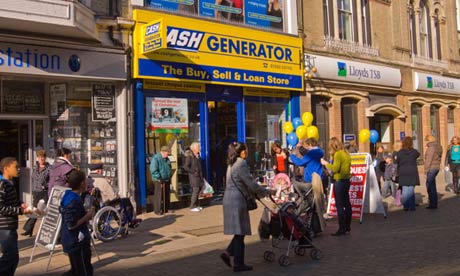
Payday lenders have broken a series of promises to reform their industry, including pledges to check that their loans are affordable and to freeze charges when people struggle to repay, according to new research that raises fresh concerns about how they operate.

A survey conducted by Citizens Advice also found that most lenders are failing to remind clients that their loans, which can carry equivalent annual interest rates in excess of 5,000%, are not a long-term fix. Nor do they check whether the borrower can pay back the money.

The findings are likely to be studied closely by MPs and debt counselling organisations who are increasingly concerned about the industry's tactics – which have come into sharp focus during the economic downturn.

Six months on from the launch of an industry charter to deflect criticism of how it operates, evidence to be released on Tuesday by Citizens Advice found lenders had broken 12 of 14 of their industry pledges to treat customers fairly.

A loan tracker service, set up by Citizens Advice examining about 2,000 loans taken out with 113 lenders, found that 87% of lenders did not ask the borrower to provide documents to show they could afford the loan, while 58% failed to explain that the loan should not be used for long-term borrowing.

Of those who had repayment problems with payday loans, seven out of 10 said they had been put under pressure to extend the loan, while 84% said they had not been offered a freeze on interest rates and charges when they said they were struggling to repay. In 95% of cases the lender had not checked to see if the borrower could pay back the loan if it were extended.

"It is a damning indictment of an irresponsible and careless industry that payday lenders have not been serious about their commitment to treat customers fairly," said Gillian Guy, chief executive of Citizens Advice.

In the last four years Citizens Advice bureaux have seen a 10-fold increase in payday loans, sparking concerns that more people are relying on the operators to help them get by.

Citizens Advice gave the typical example of an 18-year-old unemployed person who had received a payday loan of £50 to pay their mobile phone bill, despite telling the lender they lived on just £208 a month. After repaying the loan, they took out another and kept receiving texts and emails offering more. After three months they had racked up loans of £500 coupled with interest charges of £300.

"Borrowers who hoped for a bit of cash to tide them over are now harrowed by debt and find themselves in a vicious cycle of payday loans, without any sign of a way out," Guy said. "It's hugely disappointing that the industry has held its hands up and admitted it could do more – but has completely failed to do so. We want payday lenders to start sticking to their promises and stop ruining people's lives with irresponsible lending."

Citizens Advice, which is calling on the industry to stand by its commitment to treat customers fairly and stop sending them into a spiral of debt, has called on high-street banks to offer personal micro-loans as a responsible alternative.

The Office of Fair Trading is investigating the payday loan industry and has given 50 lenders a 12-week deadline, which expires on Tuesday, to improve. Of those under review, 48 have confirmed that they will provide the OFT with proof that they are fully compliant with their charter, while two of the lenders have surrendered their licences.

"I am very disappointed to see these worrying findings from Citizens Advice," said the consumer minister, Jo Swinson. "Consumers, and particularly those who are most vulnerable and struggling financially, should expect lenders to treat them in a way which matches up to the commitments made in industry codes. This is clearly not happening and more needs to be done to address the problems we are seeing. Tough enforcement and compliance by the Office of Fair Trading (OFT) now, combined with a move to a new regulatory regime under the new Financial Conduct Authority (FCA) in 2014, will tackle the real concerns in this market."

In February, Citizens Advice reported four payday lenders to the OFT and called for them to be immediately banned from trading. Last August it provided evidence to the OFT's investigation that saw lender MCO Capital Limited stop trading.

The OFT has opened formal investigations into the practices of three lenders and, in addition, three others have also had their licences revoked since its review of the sector began in March.

"Irresponsible payday lenders are on notice – if you don't clean up your act, the consequences will be severe," Swinson said.

Truth behind the death of suffragette Emily Davison is finally revealed

Hi-tech film analysis suggests Emily Davison's motives when she collided with the king's horse in 1913 were misunderstood

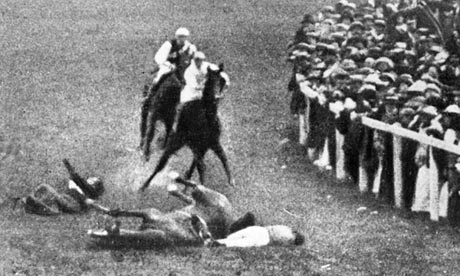
As an emblem of women's emancipation Emily Wilding Davison has always been controversial. The suffragette who was fatally injured at the Epsom racecourse during the Derby 100 years ago under the hooves of the king's horse has been saluted by some as a brave martyr and attacked by others as an irresponsible anarchist. Now detailed analysis of film footage of the incident has shed new light on the contentious moments on 4 June 1913 that were to go down in the history of political protest.

Despite the fact that film technology was in its early days, the incident was captured on three newsreel cameras and a new study of the images has shown that the 40-year-old campaigner was not, as assumed, attempting to pull down Anmer, the royal racehorse, but in fact reaching up to attach a scarf to its bridle.

The analysis, carried out by a team of investigators for a television documentary to be screened tonight on Channel 4, also indicates that the position of Davison before she stepped out on to the track would have given her a clear view of the oncoming race, contrary to the argument that she ran out recklessly to kill herself.

Presenter Clare Balding and investigators Stephen Cole and Mike Dixon returned to the original nitrate film stocks taken on the day and transferred them to a digital format. This was done so that they could be cleaned and so that new software could cross-reference the three different camera angles.

"It has been such an extraordinary adventure to discover more about her, about what she stood for, about the suffragette movement," said Balding this weekend on her work with the team making Secrets of a Suffragette.

"It is hugely significant as a moment in history, a moment that absolutely sums up the desperation of women in this country who wanted the vote."

Historians have suggested that Davison was trying to attach a flag to King George V's horse and police reports suggested two flags were found on her body. Some witnesses believed she was trying to cross the track, thinking the horses had passed by, others believed she had tried to pull down Anmer. The fact that she was carrying a return train ticket from Epsom and had holiday plans with her sister in the near future have also caused some historians to claim that she had no intention of killing herself.

In 2011 the horse-racing historian Michael Tanner argued that as Davison was standing in crowds on the inside of the bend at Tattenham Corner it would have been impossible for her to see the king's horse.

But new cross-referencing between the cameras has revealed, say the C4 programme makers, that Davison was closer to the start of Tattenham Corner than thought and so had a better line of sight. In this position she could have seen and singled out Anmer.

Historians have suggested that Davison and other suffragettes were seen "practising" at grabbing horses in the park near her mother's house and that they then drew lots to determine who should go to the Derby.

After colliding with Anmer, Davison collapsed unconscious on the track. The horse went over, but then rose, completing the race without a jockey. Davison died of her injuries four days later in Epsom Cottage Hospital.

At the funeral of the leading suffragette Emmeline Pankhurst in 1928, the jockey who had ridden Anmer that day, Herbert Jones, laid a wreath "to do honour to the memory of Mrs Pankhurst and Miss Emily Davison". Jones had suffered a mild concussion in the 1913 collision, but afterwards claimed he was "haunted by that poor woman's face".

In 1951, his son found Jones dead in a gas-filled kitchen. The jockey had killed himself.
 

Sample text

Sample Text

Sample Text